

Selecting the right mesh count is critical in Silk Screen Printing for sports apparel. Whether you print bold team logos or detailed player names, mesh count directly affects ink flow, color vibrancy, and overall durability.
In this guide, you will learn how to choose the correct mesh count for different sports printing applications and why it matters for professional results.
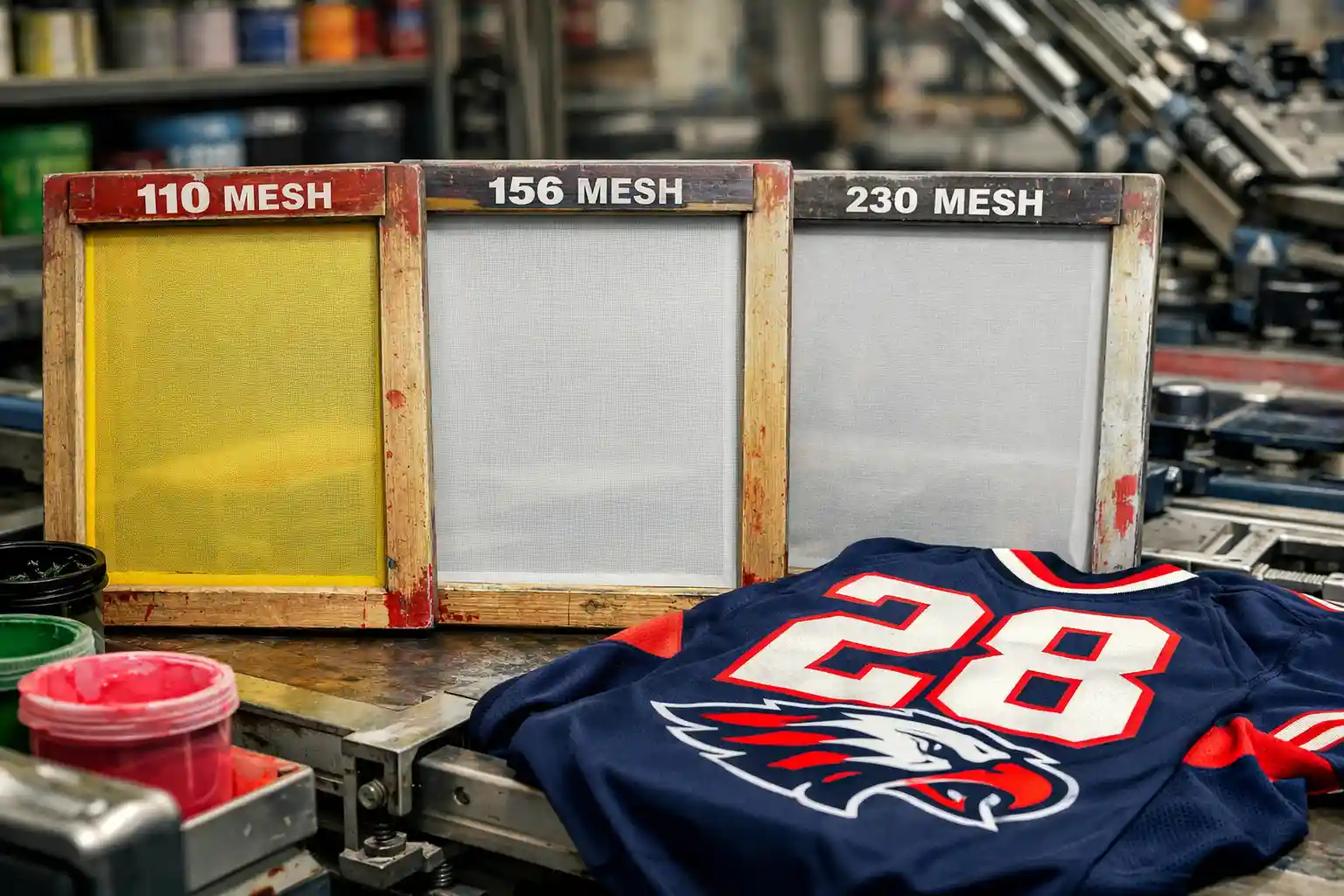
In Silk Screen Printing, mesh count refers to the number of threads per inch in a screen. For example, a 110 mesh screen has 110 threads per inch.
Lower mesh counts allow more ink to pass through. Higher mesh counts deposit less ink but capture fine detail.
Therefore, choosing the right Silk Screen Printing mesh count for sports prints ensures clarity, durability, and proper ink coverage.
Sports apparel demands durability. Jerseys experience stretching, washing, and physical contact. Because of this, ink thickness and bonding must be optimized.
Mesh count affects:
Ink deposit thickness
Detail sharpness
Color opacity
Print durability
Specialty ink performance
If the mesh is too low, detail may blur. However, if it is too high, ink coverage may appear weak on dark jerseys.
This range is ideal for:
Large player numbers
Bold team names
Printing on dark fabrics
Puff ink or specialty inks
Because lower mesh allows more ink flow, it creates vibrant and durable prints. For football or basketball jerseys, 110 mesh is often preferred.
This is the most versatile option in Silk Screen Printing for sports apparel.
It works well for:
Multi-color team logos
Medium detail graphics
General athletic apparel
Moreover, it balances ink deposit and detail retention effectively.
Higher mesh counts are ideal for:
Fine text
Detailed mascot graphics
Lightweight performance fabrics
Although less ink passes through, the detail becomes sharper. As a result, designs appear cleaner and more professional.
Not all sports fabrics behave the same way.
Polyester is common in sportswear. It requires careful mesh selection to prevent dye migration. Typically, 110–160 mesh works well with low-bleed inks.
Cotton absorbs ink more easily. Therefore, higher mesh counts such as 160–200 may provide sufficient coverage.
Blends often require testing. Since fabric composition varies, choosing the right Silk Screen Printing mesh count for sports prints depends on ink type and garment stretch.
Ink choice significantly impacts results.
Plastisol Ink: Works well with 110–160 mesh
Water-Based Ink: Often requires 156–230 mesh
Puff Ink: Best with lower mesh like 86–110
Discharge Ink: Performs better with higher mesh counts
For more technical screen printing standards, review this comprehensive resource from
Screen Printing Mesh Guide – Ryonet
https://www.ryonet.com/blog/screen-printing-mesh-count-guide/
Additionally, you can explore advanced production techniques from
Screen Printing Tips – Printwear Magazine
https://www.printwearmag.com/
Many beginners make preventable errors.
Using high mesh for bold block numbers
Selecting low mesh for detailed logos
Ignoring ink viscosity
Skipping test prints
Testing remains essential. Even experienced printers run sample prints before production.
If you want consistent and durable sports prints, working with experienced professionals makes a difference. At ShopD2S, we specialize in high-performance athletic apparel printing.
Explore our professional Silk Screen Printing services here: https://shopd2s.com/
Our team ensures the correct mesh count, ink selection, and curing process for every sports project.